
Contributor News
America First, China Last: Trump’s “Art of the Tariff,” A Winning Strategy?

On Wednesday, President Donald Trump shook the global economic landscape with a dramatic tariff announcement, escalating tensions with China while offering a reprieve to most other trading partners. This move, paired with insights from Treasury Secretary Scott Bessent’s recent interview with Tucker Carlson, provides a window into the administration’s ambitious plan to reshape international trade and bolster the American economy. Here’s what you need to know about the strategy, its implications, and the latest developments.
Bessent Breaks Down the Tariff Vision
In a revealing long-form interview with Tucker Carlson, Treasury Secretary Scott Bessent laid out the intellectual and practical foundations of Trump’s tariff plan, framing it as a transformative shift for the American worker and a reassertion of U.S. economic leverage. Bessent, a seasoned global investor turned policymaker, emphasized that tariffs are not a whimsical reaction but a deliberate tool rooted in history and strategy.
“President Trump has been talking about this for four decades,” Bessent told Carlson. “This is transformational for the American economy, for the American worker, and for the new Republican alignment.” He drew a historical parallel to Alexander Hamilton, America’s first Treasury Secretary, who used tariffs to fund the fledgling nation and protect its industries. Trump, Bessent argued, adds a modern twist: using tariffs as a negotiating hammer to force fairer trade deals. “He’s better than anyone at giving himself maximum leverage,” Bessent said, highlighting Trump’s April 2 rollout of a baseline 10% tariff on imports from over 180 countries, followed by today’s refinements.
Bessent dismissed fears of immediate economic fallout, pointing to deeper structural goals. “In the short run, the market’s a voting machine; in the long run, it’s a weighing machine,” he said, quoting Warren Buffett. He argued that sound fundamentals—stable taxes, deregulation, and cheap energy—would outweigh temporary market jitters, such as those triggered by China’s AI advancements (e.g., DeepSeek) rather than tariffs alone. For the middle class, Bessent promised relief through tariff revenues potentially funding tax cuts, like eliminating taxes on tips and shifting the burden away from American taxpayers.
Today’s Announcement: China Faces 125%, Others Get a 90-Day Pause
Fast forward to April 9, 2025, and Trump’s latest move has crystallized this strategy. In a Truth Social post timestamped at 1:18 PM EST from the White House, Trump announced an immediate escalation of tariffs on Chinese imports to 125%, up from the 104% imposed earlier this week. “Based on the lack of respect that China has shown to the World’s Markets,” Trump wrote, “I am hereby raising the Tariff charged to China by the United States of America to 125%, effective immediately.” This hike follows China’s retaliatory increase of tariffs on U.S. goods to 84%, a move Bessent called a “loser” on Fox Business, noting China’s export-heavy economy is five times more dependent on the U.S. than vice versa.
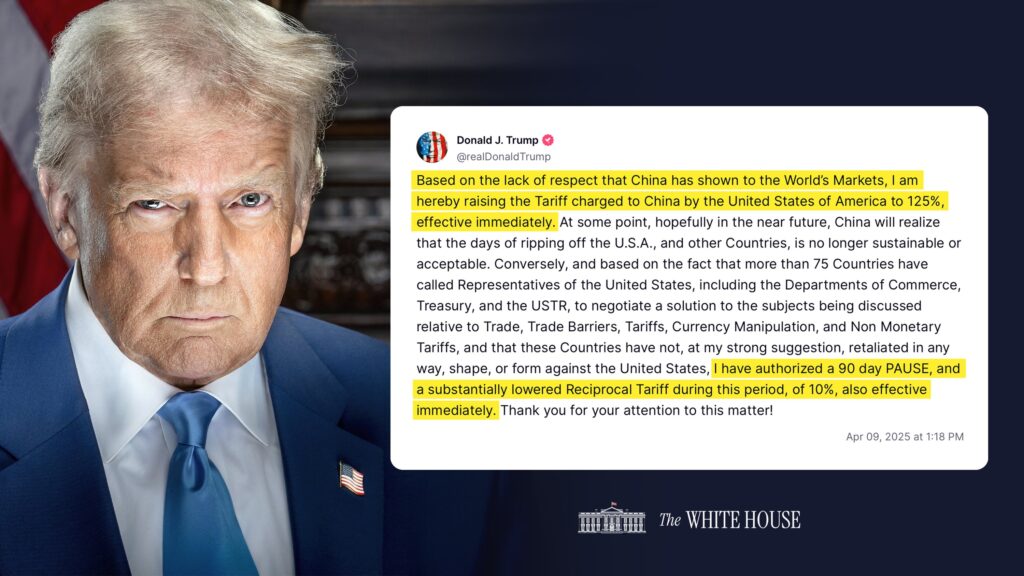
Meanwhile, Trump extended an olive branch to most other nations. Citing outreach from “more than 75 countries” eager to negotiate, he authorized a 90-day pause on the higher “reciprocal” tariffs announced last week, reducing them to a uniform 10% during this period, effective immediately. “These countries have not, at my strong suggestion, retaliated in any way, shape, or form against the United States,” Trump stated, signaling a reward for cooperation. The White House later clarified that this pause excludes China but applies broadly to allies like Japan, with which Bessent has already begun negotiating alongside U.S. Trade Representative Jamieson Greer.
What’s the “Reciprocal” 10% All About?
The term “reciprocal” is central to Trump’s tariff lexicon, and Bessent’s interview offers clarity. It’s about leveling the playing field. The administration calculates a “number” for each country—reflecting their tariffs, non-tariff barriers (like regulations or subsidies), currency practices, and trade imbalances—and aims to match or exceed it unless concessions are made. The initial April 2 plan set a 10% baseline, with higher rates for the “Dirty 15” (countries with the most restrictive practices), but today’s 90-day pause resets most nations to this 10% floor. It’s a carrot-and-stick approach: don’t retaliate, negotiate in good faith, and the rate stays low—or drops further. Retaliate, as China did, and face escalation.
Bessent reinforced this on Carlson’s show: “If you don’t retaliate, this is the high end of the number.” He sees the pause as a signal of Trump’s willingness to deal, noting that 50 to 70 countries (estimates vary slightly) have already reached out, including Japan, which Trump personally engaged via a call with Prime Minister Shigeru Ishiba. “It’s going to be a busy April, May, maybe into June,” Bessent told Fox Business, predicting Japan might get priority for its quick response.
China’s Defiance and the Global Response
China’s refusal to negotiate has set it apart. Bessent lamented to Carlson that “the biggest offender in the global trading system” won’t budge, a stance echoed in Trump’s announcement. China’s State Council Tariff Commission called the U.S. escalation “a mistake upon mistake,” vowing to fight on, bolstered by a public increasingly supportive of standing up to America. Experts like Cornell’s Wendong Zhang warn of further escalation, noting China’s reduced reliance on U.S. goods since the 2018-19 trade war.
Contrastingly, the 75+ countries contacting the U.S.—a figure Bessent pegged at “50, 60, maybe almost 70” on Fox—signal a willingness to align with Trump’s vision. While specific names beyond Japan remain unconfirmed, Bessent told the American Bankers Association that deals with allies are feasible, warning others against siding with China: “That would be cutting your own throat.”
What’s Next?
As Bessent has emphasized, the 90-day pause offers a window for negotiations, with Trump taking a hands-on role. Success could mean lower tariffs and new trade pacts; failure could see the higher reciprocal rates snap back. The 125% tariff is a gauntlet thrown down for China, daring Beijing to blink. As Bessent told Carlson, this isn’t just about trade—it’s about redefining America’s economic destiny. “The American Dream isn’t access to cheap goods,” he said. “It’s prosperity, upward mobility, and security.” Whether Trump’s gamble pays off remains to be seen, but today’s announcement marks a pivotal chapter in that story.