Contributor News
Trump Lands in China With $10 TRILLION CEO Army — And the Stakes Couldn’t Be Higher

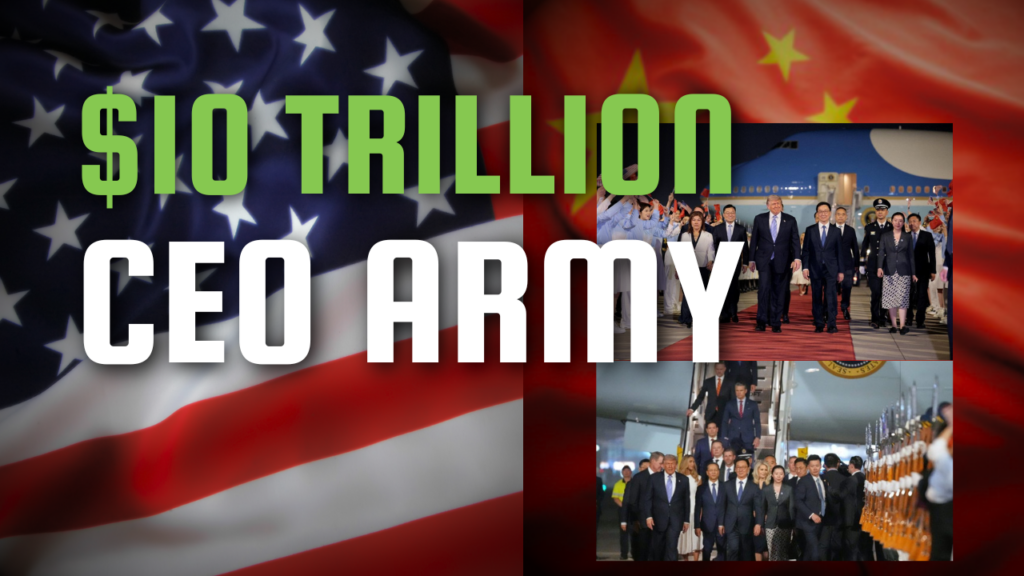
President Donald Trump touched down in Beijing today aboard Air Force One, greeted with full military honors for a two-day summit with Chinese President Xi Jinping. What makes this visit unique isn’t just the pageantry, it’s the largest corporate delegation ever to accompany a sitting U.S. president, showing a bold America-first push on trade, technology, and global energy security.
Wheels down in Beijing!
— The White House (@WhiteHouse) May 13, 2026
President Donald J. Trump lands for a landmark summit with China, greeted by Vice President Han Zheng during a welcome ceremony. pic.twitter.com/4q2mATZrn4
The President was joined by more than a dozen top American CEOs representing trillions in market value, including Elon Musk of Tesla, Tim Cook of Apple, Jensen Huang of Nvidia (who boarded during a last-minute refueling stop in Alaska), Larry Fink of BlackRock, Stephen Schwarzman of Blackstone, Kelly Ortberg of Boeing, and executives from Goldman Sachs, Citigroup, GE Aerospace, Qualcomm, Micron, Cargill, and others. The White House confirmed that the group spans tech, finance, aerospace, and agriculture, and includes companies hungry for greater market access, chip licenses, supply chain deals, and investment opportunities in China.
Speculations abound with analysts and observers already abuzz: a delegation this powerful doesn’t fly halfway around the world unless substantial breakthroughs have already been teed up behind the scenes. As one noted, “Trump doesn’t take all these people to China to be embarrassed. It’s all been agreed to already.” The sheer scale, over $10 trillion in combined market cap, suggests pre-summit groundwork that might reform U.S.-China trade overnight if Xi delivers on opening markets to American business.
The timing is no coincidence. Looming large over the talks is the ongoing Iran conflict and its spreading consequences on global oil supplies. China has long been a major buyer of Iranian crude, but U.S. pressure on Tehran, including disruptions in the Strait of Hormuz, has tightened the screws on Beijing’s energy needs. Trump is reportedly leveraging America’s position as an energy superpower, offering China alternative U.S. oil and gas supplies in exchange for help pressuring Iran to stand down and support price stability.
Conservative commentators like Bill O’Reilly stated this is one of Trump’s biggest gambles yet: use the summit to negate Iran’s influence, flood markets with cheaper American energy, and deliver relief at the pump ahead of the midterms. O’Reilly, citing direct conversations with Chinese officials, said Beijing may be open to helping “tamp Iran down” in return for discussions on Taiwan, though not a handover, just “the beginning of a discussion.” He called it a pragmatic win for U.S. interests, noting China values order above all and doesn’t want chaos in the Gulf.
Formal talks kick off on Thursday, with expectations of announcements on trade concessions, AI cooperation, and supply chain realignments. Trump has made clear the goal: reciprocal deals that put American workers and businesses first, no more one-sided arrangements that hollowed out U.S. manufacturing. Critics on the left are already disparaging the CEO-heavy approach as “corporate welfare.”
Still, supporters see this visit as smart power, bringing the full weight of American enterprise to the table. Markets are watching closely: any positive signals could spark a rally, while silence or stonewalling from Xi would be priced in immediately. This isn’t just another diplomatic trip. It’s Trump playing four-dimensional chess on trade, energy, and geopolitics, all with the world’s biggest corporations riding shotgun. Outcomes can reshape inflation, national security, and the 2026 midterms.