
Contributor News
Israel-Iran Ceasefire Begins After Trump’s Direct Intervention

A ceasefire has officially been declared between Israel and Iran, bringing an end to a 12-day conflict that had the world on edge. The announcement came from U.S. President Donald J. Trump on Monday, June 23, 2025, in a post shared on Truth Social, where he stated that a “complete and total ceasefire” had been agreed upon by both nations.
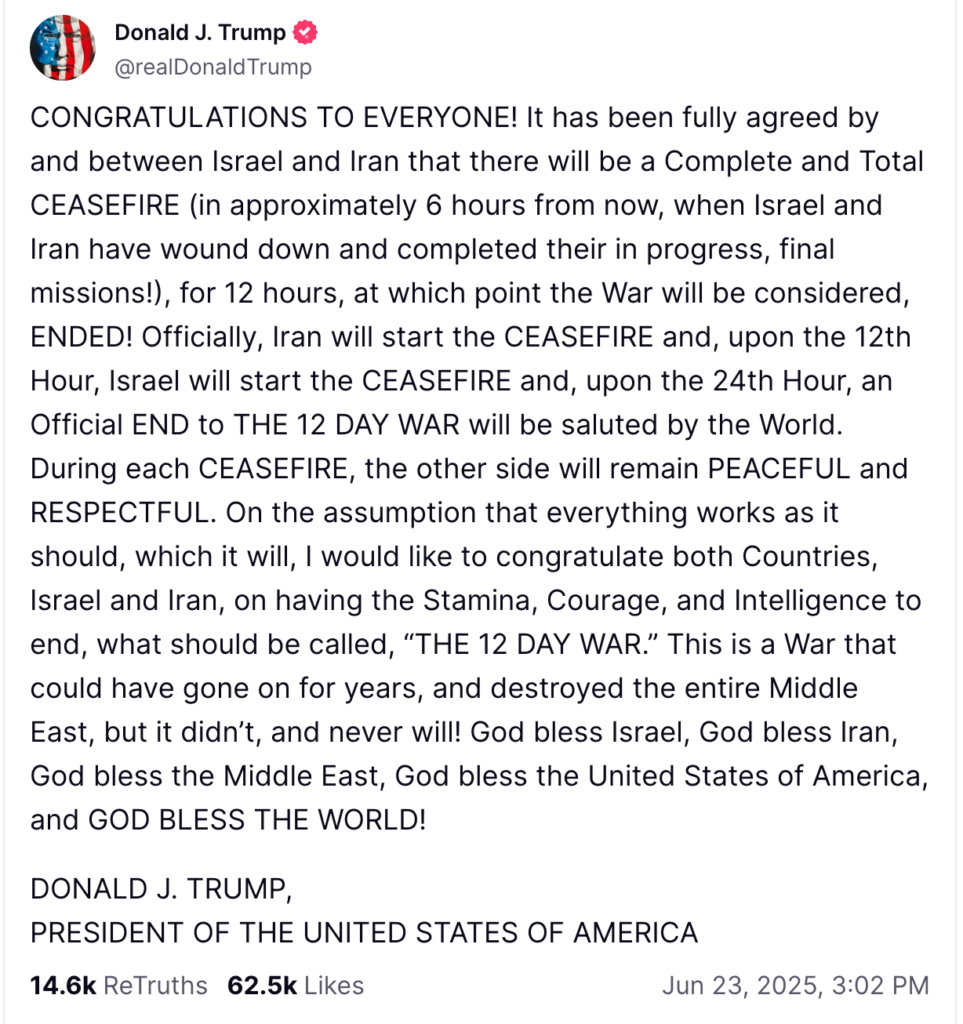
According to the statement, the ceasefire is scheduled to begin roughly six hours from the announcement—once final military operations by both countries are completed. The agreement will start with a 12-hour initial ceasefire, during which both sides are expected to remain peaceful and respectful. Iran is set to initiate the ceasefire, with Israel following at the 12-hour mark. At the 24-hour point, the ceasefire will be recognized globally as the official end of what Trump has called the “12-Day War.”
The conflict began on June 12, when Israel launched Operation Rising Lion, targeting key Iranian military and nuclear sites—including the Natanz facility—to disrupt Iran’s nuclear program. In response, Iran launched a series of missile and drone attacks on Israeli cities and infrastructure, escalating tensions quickly. By June 17, Israel reported heavy damage to Iran’s ballistic missile systems, while Iran continued to retaliate with strikes of its own. Civilian casualties mounted on both sides, with reports estimating over 200 deaths in Iran and at least 24 in Israel.
A critical escalation occurred over the weekend when the United States conducted strikes on three key Iranian nuclear sites—Natanz, Isfahan, and Fordow—as part of Operation Midnight Hammer. This operation, detailed by U.S. Chairman of the Joint Chiefs of Staff Air Force Gen. Dan Caine during a Pentagon briefing hours later, June 22nd, involved B-2 bombers and Tomahawk missiles, marking the largest B-2 strike in U.S. history.
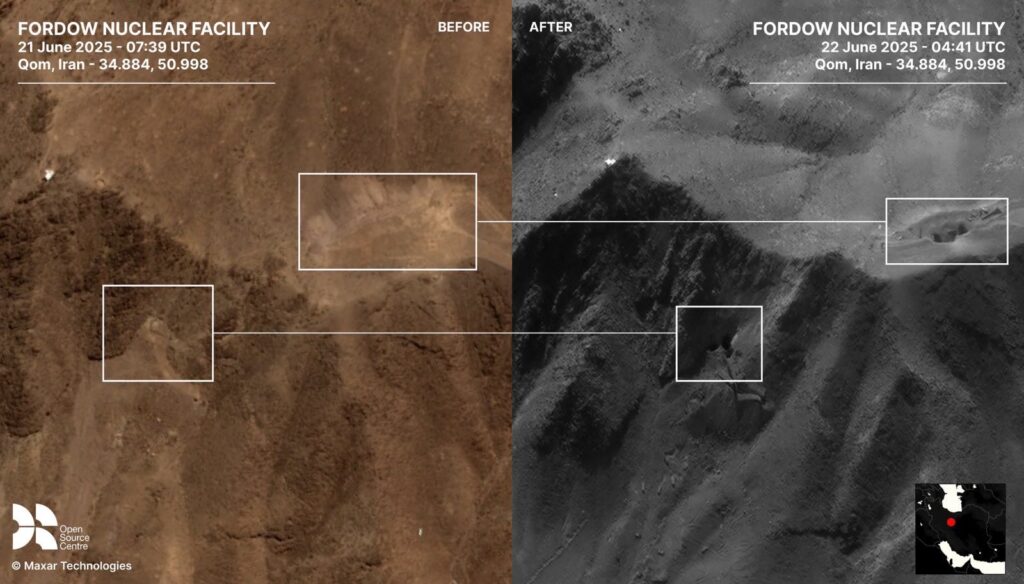
The mission, executed with high precision, aimed to severely degrade Iran’s nuclear infrastructure. Caine reported that 14 bunker-buster bombs, including the 30,000-pound GBU-57 Massive Ordnance Penetrator, were dropped, inflicting severe damage on the targeted facilities. The operation involved over 125 aircraft and maintained operational security, with no shots fired at U.S. forces during the mission.
President Trump addressed the nation, confirming the strikes and describing them as a “military success.” He stated that the strikes had “completely and fully obliterated” Iran’s key nuclear sites, emphasizing the U.S. commitment to defending Israel and preventing Iran from acquiring nuclear weapons. Trump’s press conference, held at the White House, was attended by Vice President JD Vance, Secretary of State Marco Rubio, and Defense Secretary Pete Hegseth, who reiterated the administration’s stance on the operation’s necessity.
The situation intensified further on Monday when Iran retaliated by launching missiles at the U.S. Al Udeid Air Base in Qatar, though most were intercepted with no reported casualties. Diplomatic efforts gained momentum, with U.S. Special Envoy Steve Witkoff engaging Iranian officials on June 17th, though Iran initially signaled reluctance to negotiate without achieving its goals. Israeli officials later indicated on June 22nd that military objectives were nearing completion, potentially paving the way for a ceasefire.
President Trump’s statement today struck a hopeful tone, commending both Israel and Iran for their “stamina, courage, and intelligence” in reaching a peaceful resolution. He noted that the war could have easily spiraled into a prolonged and devastating conflict but didn’t—and he expressed hope that it never will.
The message concluded with Trump extending blessings over both nations, the Middle East, the United States, and the world—reaffirming his long-held commitment to avoiding endless wars and securing peace through strength. Despite frequent criticism from opponents claiming he would lead America into global conflict, Trump once again positioned himself not as a warmonger but as a peacekeeper determined to put diplomacy and American interests first.