
Contributor News
Trump at Davos: Economic Revival, America First—and the Strategic Case for Buying Greenland

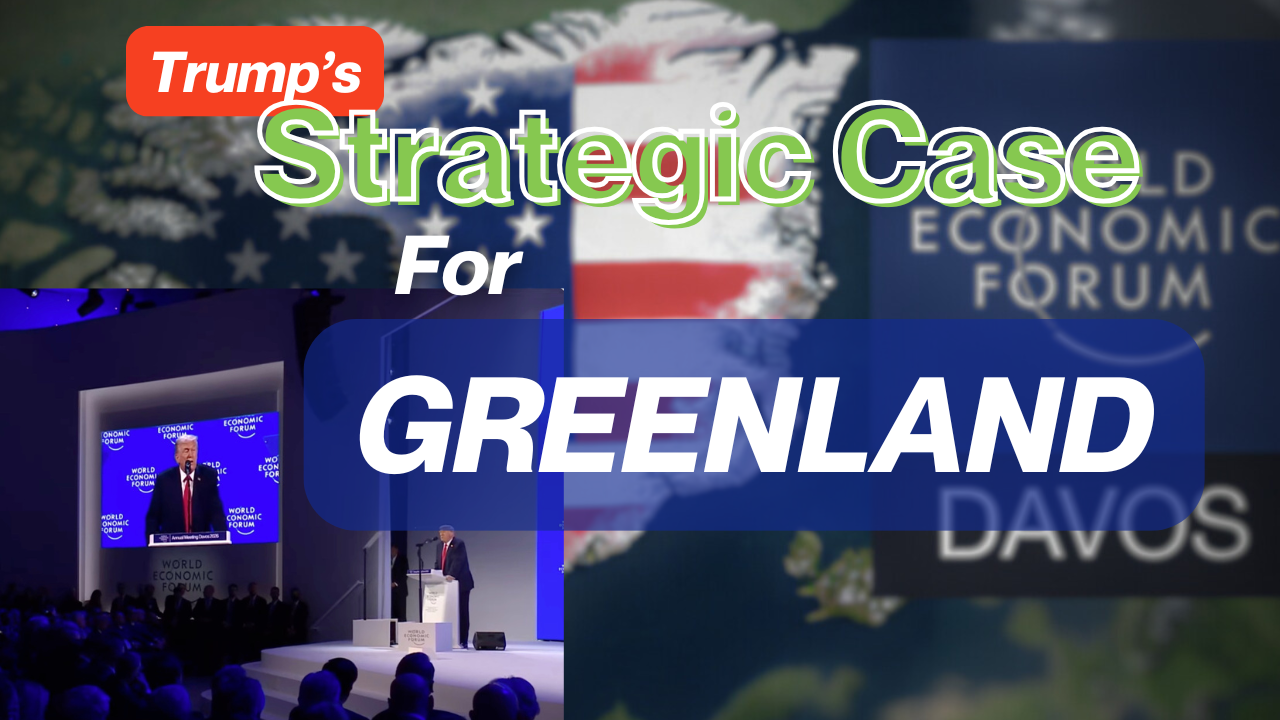
One year and one day into an unprecedented second term, President Donald J. Trump stood again before the World Economic Forum in Davos.
In a commanding speech, President Trump showcased America’s stunning economic revival while laying out a bold “America First” agenda that includes acquiring Greenland from Denmark. While laced with sharp critiques of globalist policies and the Biden-Harris era’s failures, it resonated as a rallying cry for national sovereignty and prosperity. But it was his renewed push for Greenland echoing historical U.S. interests that underscored how melting Arctic ice caps are reshaping global trade and security, demanding American leadership to protect our hemisphere under the principles of the Monroe Doctrine.
Trump opened by lauding unprecedented economic wins, proving that conservative policies of tax cuts, deregulation, and tough trade deals deliver real results for hardworking Americans. “We’ve achieved record growth—5.4% projected in Q4—with core inflation at a low 1.6%,” he declared, crediting reversals of Biden’s “stagflation” nightmare. The stock market has hit 52 all-time highs, adding $9 trillion in value, while $18-20 trillion in new investments flood in. Over 1.2 million Americans are off food stamps, federal spending is down $100 billion, and the budget deficit slashed by 27%. Tariffs have cut the trade deficit by 77%, boosted exports by $150 billion, and revived steel production by 300,000 tons per month.
Energy independence, a cornerstone of Republican strength, was front and center. Trump blasted the “Green New Scam” for crippling economies like Europe’s, where Germany’s electricity production is down 22% with prices 64% higher, while the UK’s energy output is a third of 1999 levels and costs are 139% higher. In contrast, America’s oil and gas leases are booming after a 95% drop under Biden, with natural gas at record highs and gasoline under $2.50 a gallon in many states. New nuclear reactors and AI investments position the U.S. as the world’s tech powerhouse, allowing giants like Meta to build their own power plants.
Turning to immigration, Trump warned of the cultural and economic destruction from open borders—a jab at leftist policies that have turned European cities “unrecognizable.” Under his watch, the U.S. has seen its first net outflow of migrants in 50 years, with criminals deported and crime plummeting by 64% in New Orleans alone. Prescription drug prices are down 90% via “favored nations” policies, credit card interest is capped at 10%, and institutional investors are banned from snapping up family homes. But the highlight of the speech was Trump’s strategic vision for Greenland, framing it as essential to U.S. security amid rising threats from China and Russia. “Greenland is vital for our national and international security,” Trump asserted, proposing a purchase from Denmark while criticizing NATO’s “freeloading,” where America foots 100% of the bill. He hiked NATO spending requirements to 5% of GDP, insisting Europe handle Ukraine without endless U.S. handouts.
Trump isn’t pioneering this idea—America’s pursuit of Greenland dates back over 150 years, rooted in conservative foresight for hemispheric dominance.
In 1867, Secretary of State William H. Seward—fresh off buying Alaska from Russia—eyed Greenland to expand U.S. influence in the Arctic, though the deal fell through.
During World War II, the U.S. established bases there to counter Nazi threats, maintaining a presence that proved crucial. The closest we came was in 1946 under President Harry Truman, who offered Denmark $100 million (about $1.5 billion today) for the island, recognizing its role in Cold War defense.
Denmark declined, but the interest never faded, as Greenland’s position between North America, Europe, and Russia makes it a linchpin for missile defense and early warning systems.
Today, as Arctic ice caps melt due to climate shifts, Greenland’s value skyrockets.
Receding ice opens new trade routes, such as the Northwest Passage and the Northern Sea Route, slashing shipping times between Asia, Europe, and the Americas by thousands of miles.
Controlling Greenland means securing these lanes for U.S. commerce, preventing adversaries like China from dominating what Trump calls the “Silk Road on Ice.”
This isn’t just about economics; it’s national security. Greenland’s vast reserves of rare earth minerals, oil, and gas are critical for tech, energy independence, and military technology, reducing reliance on foreign suppliers.
Tying it all together is the Monroe Doctrine, the 1823 policy that declared the Western Hemisphere off-limits to foreign meddling—a conservative bulwark against imperialism.
Trump, in his Davos remarks, evoked this “Donroe Doctrine” (a nod to Monroe) to assert U.S. primacy, blocking Russian military buildup and Chinese economic incursions in the Arctic.
As ice melts, Greenland becomes the gateway to our backyard; acquiring it fortifies the hemisphere, ensures safe trade routes, and upholds America’s role as the world’s defender—without the endless subsidies Trump decried.
On geopolitics, Trump spoke confidently about settling 8 wars, predicting a Ukraine-Russia deal led by Europe, and crediting U.S. strikes for Middle East peace involving 59 countries. Relations with Xi and Putin remain strong, with a China visit planned, but competition in AI and crypto will be fierce—under fair American terms.
During a Q&A session, Trump outlined sustaining growth through tariffs and fraud cuts, paying down $36 trillion in debt, and leading in AI through private innovation. Gaza reconstruction beckons with U.S. billions, a testament to Trump’s deal-making prowess.
As Trump concluded, optimism soared: “America’s resurgence benefits the world—defend Western culture amid tech advances.” For conservatives, this is leadership: bold, unapologetic, and putting America first. Greenland isn’t a whim—it’s a strategic imperative, building on our forebears’ vision to secure prosperity for generations.
Full speech:
WATCH IN FULL: President Donald J. Trump’s address and interview at the World Economic Forum in Davos, Switzerland pic.twitter.com/RUM1NeyJr0
— Rapid Response 47 (@RapidResponse47) January 21, 2026
Continue Reading