
Contributor News
From Feelings to Friction: Justice Jackson’s Dissents Face In-House Criticism


The U.S. Supreme Court has recently issued two notable decisions that have brought attention to differing judicial perspectives, particularly those of Justice Ketanji Brown Jackson. These cases, decided within the past month, have sparked discussion due to Jackson’s solitary dissents and the subsequent remarks from her colleagues, raising questions about the Court’s adherence to objective legal interpretation.
SCOTUS Ruling on Federal Workforce Cuts
The Supreme Court delivered an 8-1 decision allowing the administration to proceed with plans to reduce the federal workforce across multiple departments, overturning previous injunctions from lower courts. Justice Ketanji Brown Jackson was the sole dissenter, contending that the Court’s action on the “shadow docket”—a fast-track process for emergency rulings—preempted necessary lower-court reviews of the plans’ legality. However, Justice Sonia Sotomayor, in a concurrence supporting the majority’s decision to grant the stay, also disagreed with Jackson.
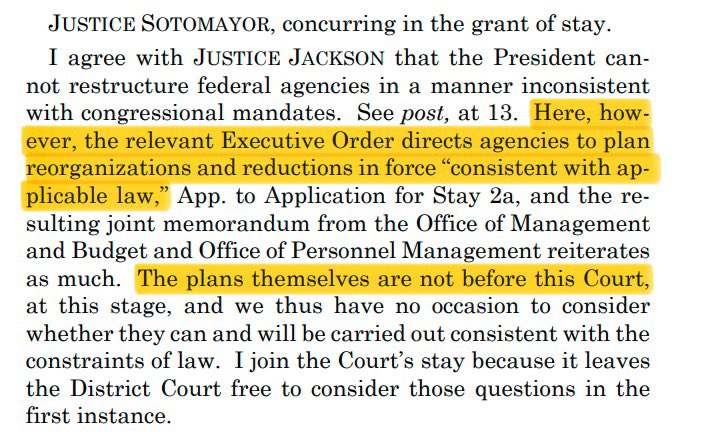
Sotomayor stated: “I agree with Justice Jackson that the President cannot restructure federal agencies in a manner inconsistent with congressional mandates. Here, however, the relevant Executive Order directs agencies to plan reorganizations and reductions in force ‘consistent with applicable law’ …” She clarified that the Court’s order was procedural—only, allowing planning, not as a green light to execute cuts, thereby preserving lower court review.
She agreed that presidential actions must align with congressional mandates but emphasized that the specific workforce reduction plans are not currently before the Court. Sotomayor’s written statement also clarified that it is premature to assess their legality, effectively correcting Jackson’s broader dissent. This rare intra-Court disagreement underscores a procedural divide even among justices with similar judicial leanings.
Earlier Decision Sparks Additional Commentary
An earlier case this term concerned whether federal district courts can issue nationwide injunctions blocking executive orders (in this case, one that would end birthright citizenship). The Court’s decision (6–3): The majority ruled that such broad injunctions exceeded judicial authority and limited their use, with Jackson as the lone dissenter. Her position drew a public response from Justice Amy Coney Barrett, who is known for her textualist approach to interpreting the law. Barrett wrote, “We will not dwell on Justice Jackson’s argument… We observe only this: Justice Jackson decries an imperial Executive while embracing an imperial Judiciary.” Barrett suggested Jackson’s dissent deviated from established legal principles, marking another instance where her reasoning has been publicly questioned by a colleague.
Jackson’s Stated Judicial Philosophy
Justice Jackson articulated her approach to her role on the Court, stating during an interview, “I think the nice part about being on the Court is, you have the opportunity, whether you’re in the majority or in the dissent, to express your opinions. I just feel that I have a wonderful opportunity to tell people, in my opinions, how I feel about the issues. And that’s what I try to do.”
Video:
Word salad in a robe pic.twitter.com/aJeUdA4xIe
— Karli Bonne’ 🇺🇸 (@KarluskaP) July 9, 2025
This highlights her emphasis on personal expression in contrast to the job requirements and the Supreme Court’s fundamental responsibility to interpret the law based on the Constitution and statutory text. This is to ensure decisions reflect legal principles rather than individual sentiments. The Court’s mandate requires justices to prioritize objective analysis over personal views, a standard that Jackson’s comments suggest she may interpret more flexibly.
Implications for Judicial Objectivity
These recent cases illustrate a tension within the Court regarding the application of judicial philosophy. Jackson’s dissents, coupled with corrections from Sotomayor and Barrett, indicate a divergence in how justices approach their duty to uphold the law. As the Court continues to address high-stakes issues, the balance between personal perspective and legal objectivity remains a critical point of scrutiny, particularly as it shapes public trust in the judicial process.